
Solitaire Grove: a calm take on classic solitaire
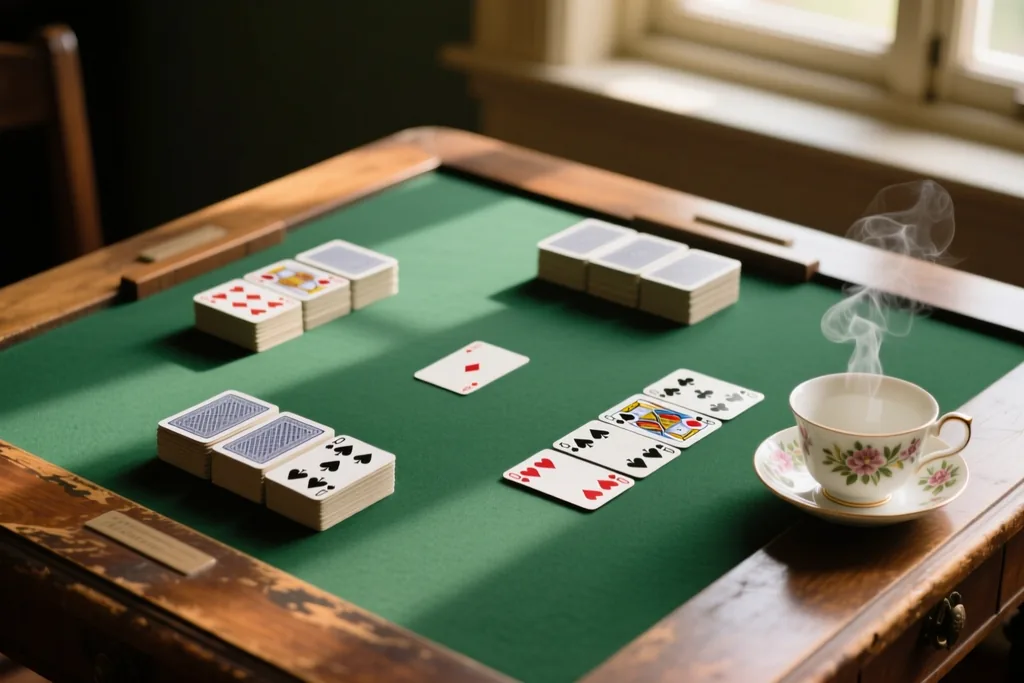
Solitaire Grove is our take on the classic card solitaire that almost everyone has played at some point. We did not set out to reinvent the rules; we set out to rebuild the feeling around them. The result is a quiet game that asks for attention rather than reflexes, and that treats a slow session as a feature rather than a failure. It is the first title we shipped under our own name, and it shaped how we think about the rest.
The rules we deliberately kept
Klondike solitaire works, and pretending otherwise would have been vanity. Its puzzles are legible, its rules fit on a single card, and its failures are almost always the player's own doing rather than the game's. We kept the draw rules, the tableau, the foundations and the win condition exactly as players expect them, because familiarity is the whole point of a comfortable game.
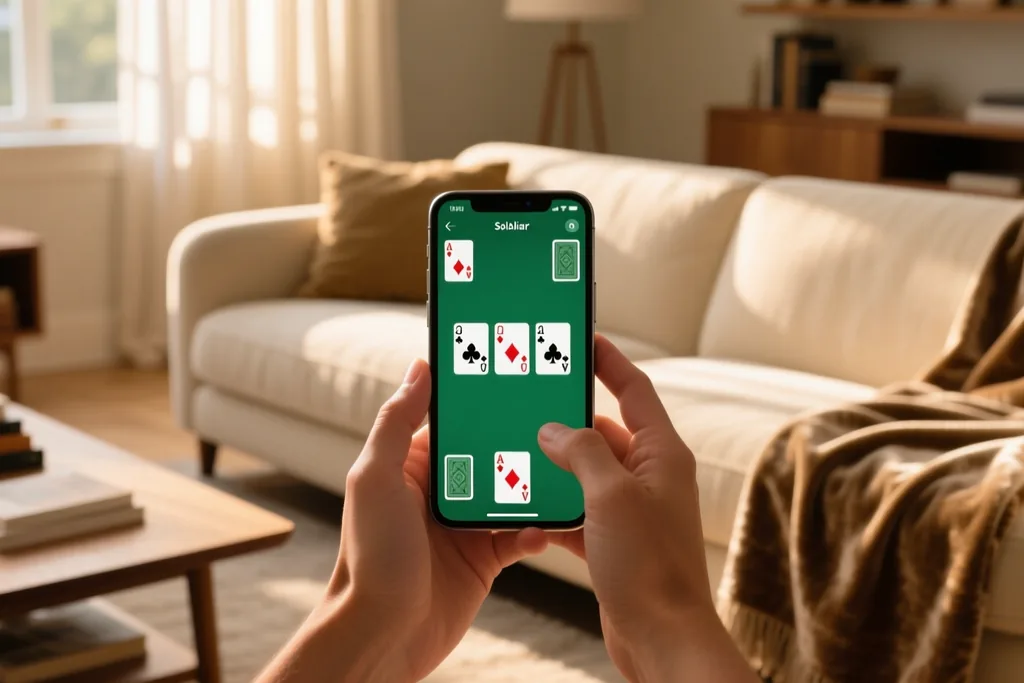
What we changed is everything around the rules: how a session begins, how it ends, and what the player sees between moves. The game never rushes you, and it never punishes you for pausing to think. That is a small promise, but it is the one the whole design serves.
Pace as a deliberate choice
A relaxed pace is not the absence of challenge; it is the absence of pressure. In Solitaire Grove there is no timer running down, no streak that breaks if you look away, and no penalty for closing the app in the middle of a hand. The only clock is the one the player brings with them, and we would rather respect that clock than compete with it.
That decision shapes every part of the interface. Animations are short and gentle, sounds are soft and optional, and the board never fills with pop-ups demanding a response. When the player decides the session is over, the game agrees without argument and remembers where they were.
Fairness, clarity and second chances
Solitaire has a reputation for deals that cannot be won, and the reputation is only partly deserved. Our job is to make sure the player can always tell the difference between a bad decision and a bad deal. That is why undos are available and generous, and why the hint feature explains rather than solves.
- Enough undos to finish a hand without anxiety creeping in.
- A hint that points at a useful move instead of playing it for you.
- No hidden rules and no sudden spikes in difficulty between hands.
None of these features win the game for the player. They simply remove the small frustrations that turn a calm habit into a stressful one, and they let a mistake teach without costing a whole session.
What a calm game asks of the player
The table below describes the trade we made, and why each part of it exists. A calm game is not a game without rules; it is a game whose rules never ambush the person holding the phone. Each row is a promise we can keep, which is the only kind worth writing down.
| Choice | What it means in play | Why we made it |
|---|---|---|
| No timer | A hand lasts as long as you like | Respect for the player's own pace |
| Generous undo | Mistakes can be taken back | Learning without punishment |
| Optional sound | Audio can be switched off | Play in any situation |
| Instant resume | The board is waiting where you left it | Fit into short breaks |
Sessions that fit into a real day
Most people who play solitaire on a phone do not play for an hour. They play for the four minutes while a kettle boils, the two stops on a train, or the quiet gap before sleep. A game that expects a long commitment will simply not be opened in those moments, however good it is.
So we optimised for the short visit. The app opens straight onto a saved board, a hand can be abandoned without consequence, and nothing is lost by leaving. Short sessions are not a compromise for this kind of game; they are the shape it should have had all along.
Who the game is for, and who it is not
Solitaire Grove is for players who want a few quiet minutes and a puzzle they already understand. It suits people who read the board slowly, who like to undo a move and think again, and who would rather finish one hand well than rush through five. It is also, deliberately, a game you can put down without losing anything.
It is not for players looking for competition, for a race against a clock, or for a stream of daily rewards to chase. We chose not to serve those appetites here, because trying to please everyone at once is how a calm game stops being calm. Knowing who a game is not for is as much a design decision as knowing who it is for, and we would rather make that choice openly than dilute the game trying to avoid it.
What this taught us as a studio
Solitaire Grove was a lesson in subtraction. Almost every improvement we made came from taking something away: a countdown, a nagging prompt, a loud sound. The rules stayed, and the game felt new. We now apply the same question to every project we touch, our own or a client's: what could we remove so the core becomes clearer? That habit started here, in a small grove of cards.
Read next
Merge Solitaire: merging cards, words and a daily puzzle
How we blend number merging with a word puzzle and why a daily loop keeps players coming back.
Flop Ball Jump: an arcade homage with modern timing
A small ball, a tall tower and the arcade heritage we borrowed from on purpose.
Memory Solitaire: training recall one match at a time
A memory matching game for short sessions and what makes recall puzzles fair and fun.