
Flop Ball Jump: an arcade homage with modern timing

Flop Ball Jump is our small homage to the arcade games that taught a generation that a single button can be enough. One ball, one tower, and a height that only ends when the timing fails. It is the simplest game we have made and, in some ways, the hardest to get right, because there is nowhere to hide when the whole experience rests on one mechanic.
The arcade heritage we borrowed
The games we grew up with were built on a bargain: an honest mechanic and a wall that gets taller. Drag the paddle, tap to jump, clear the row. Nobody explained the rules because nobody needed to, and the difficulty arrived through speed rather than through complication.
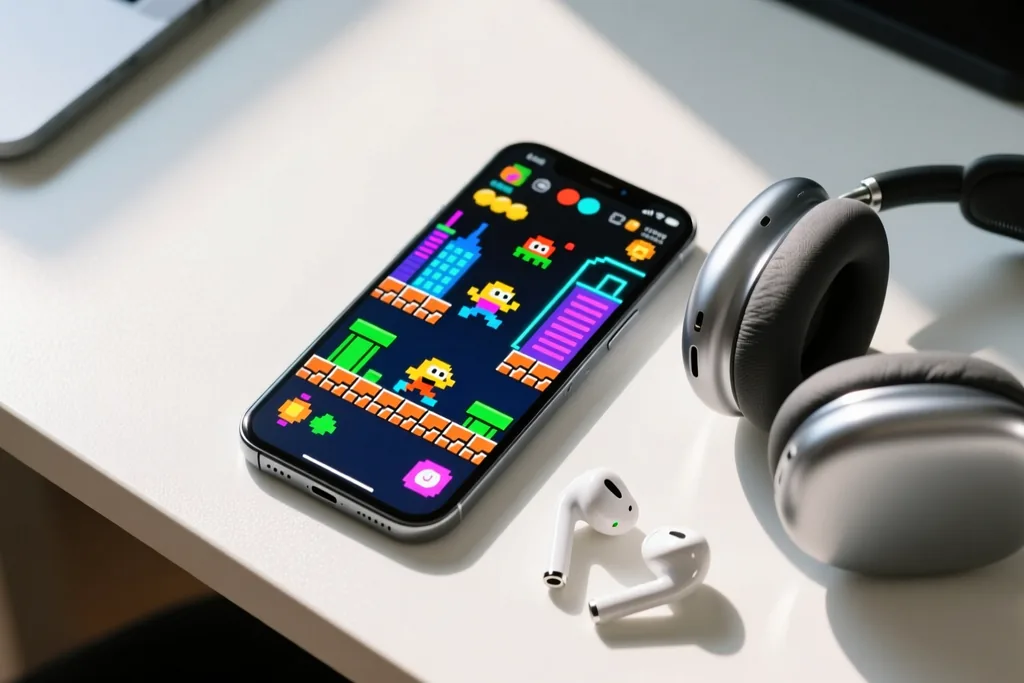
We borrowed that bargain on purpose. Flop Ball Jump adds nothing to the deal except a modern feel and a clean frame. The ambition is not to be deeper than the classics; the ambition is to be as readable as they were.
Why timing beats complexity
A timing game lives on the gap between knowing what to do and being able to do it. Widen that gap too far and the game feels random; close it completely and it becomes a chore. The craft is in tuning the window until the player always feels responsible for the outcome.
That is why we resisted adding power-ups, currencies or levels of gear. Every one of those would have diluted the single thing the game is about: the moment your thumb meets the screen at exactly the right time.
Making failure feel like a lesson
In an arcade game, losing is not an accident; it is the teaching method. A good fail tells the player what to change next time, and a bad fail leaves them guessing. We worked hard to make every collapse legible.
- The ball always fails for a reason the player can name.
- A run restarts instantly, so the lesson is not buried in menus.
- Difficulty rises in small, visible steps rather than secret jumps.
- There are no ads interrupting a run in progress.
When a game restarts in a blink, players try again. When it makes them wait, they close it. That single rule shaped more of the design than any other.
The mechanic and its demands
The table below breaks the game down to its parts. There are very few of them, which is exactly the point, and each one has to pull its weight because nothing else is there to cover for it.
| Element | What it does | What it demands of the player |
|---|---|---|
| Single tap | Makes the ball jump | Accurate timing |
| Rising tower | Sets the pace of the run | Composure under speed |
| Instant restart | Begins a fresh attempt | Willingness to try again |
| Score line | Marks the best run | A reason to push further |
Short sessions, long memory
An arcade run is meant to be finished quickly, whether the player wins or not. That shape suits a phone: a run lasts less than a minute, it can be abandoned at any point, and the next one is always one tap away. Nothing accumulates against the player between sessions.
We like this shape because it makes the game honest. There is no daily energy, no waiting timer, no nudge to spend. The only thing you can bring to the tower is a steadier hand than last time, and the only thing you can lose is a little attention.
Tuning the jump window
The single most important number in Flop Ball Jump is not the size of the ball or the height of the tower; it is how long the jump input stays valid. Too short and the game feels unfair, too long and it plays itself. We tuned that window over many small iterations, watching where testers blamed the game rather than themselves.
Whenever an experienced player failed and said the game was wrong, the window was usually the culprit. Whenever a beginner never failed at all, it was too generous. The final setting is not the easiest one we tried; it is the one where the player's steady improvement was clearest, which is the only kind of difficulty an arcade game should offer.
We keep the raw numbers of that window out of our build notes on purpose. They belong to this game and this ball, and copying them into another project would be a mistake. What transfers is the method: watch where players blame the game, and treat that as your tuning error until you have proved otherwise.
What a one-button game teaches a studio
Flop Ball Jump is the smallest game we have built, and it corrected us the most. It showed us how much of a game's difficulty lives in feedback rather than in rules, and how much better a restart feels when it is instant. Whenever a client's core loop feels sluggish, one of the first things we ask is whether their players can fail and try again without friction. This little tower is why we ask.
Read next
Solitaire Grove: a calm take on classic solitaire
Our cosy card game, the design choices behind it and what a relaxed pace asks of the player.
Merge Solitaire: merging cards, words and a daily puzzle
How we blend number merging with a word puzzle and why a daily loop keeps players coming back.
Memory Solitaire: training recall one match at a time
A memory matching game for short sessions and what makes recall puzzles fair and fun.